lunes, 16 de mayo de 2011

Road Blocks to a Pan European Market for PSI Reuse, a long summary

Note: This article is a translation with a few add-ons of what I wrote in Spanish for my personal blog. You can see the original post in Spanish: "Obstáculos para el desarrollo de un mercado pan-europeo de reutilización, un largo resumen".

SharePSI #daa1psi
Source: ePSIplatform
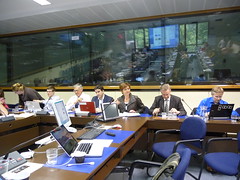
On Tuesday 10th and Wednesday 11th I participated in Brussels at the workshop "Removing Road Blocks to a Pan European Market for PSI Reuse" held by the Share PSI initiative. It was superbly organized by W3C y ETSI for the European Commission, and gathered a good number of members of the European open data community: governments, businesses and civil society organizations.
The European Commission will use the output of the SharePSI workshop at the 1st Digital Agenda Assembly event: "Beyond raw data: public sector information, done well". Ultimately the contributions, like those obtained through the public consultation on Open Data held at the end of 2010, will help to make the reform of the PSI directive richer and more effective.

In my opinion, compared to other seminars, the level of the discussion was very high in most of the sessions, though there are a few topics that are recurrent in this type of events (pricing, licensing, return of investment and privacy). Clearly, this shows that we are not being able to resolve the issues satisfactorily. In a few occasions it was also clear that not everyone is at the same level of discussion, but it is entirely normal because the open data community is growing at a rapid pace and many new people are joining the discussion.

I think the seminar was very intense and productive and this was largely due to the excellent work done by the program committee and especially by Margot Dor (ETSI) and Thomas Roessler (W3C) to create the workshop programme from the large number of position papers sent from all over Europe.

As you know I usually attend this type of events, and this time one of the things that caught my attention was, the presence of representatives of large companies in the discussion. It was rare until now that Adobe, IBM or Orange were interested in the Open Data movement. And I strongly believe that this is a good thing, because their software and their position in the IT services in governments can provide solutions that will drive the development of a more effective Open Data.

I guess that their presence has much to do with W3C and ETSI. I hope they are here to stay and contribute much to the debate and the solutions, though for now they are still far from the more advanced group. However, I also believe that it is the responsibility of those of us who have been long time in the debate, to bring them to the vision of what is the main objective of the Big Idea, Open Data, but well done.

I will also highlight the number of national government representatives that I could identify in the room (at least from Spain, Denmark, the Netherlands and Finland). And New Zealand representation in the person of Laurence Millar, who described us the situation in his country, which is enviable in many respects, such as the very active community of developers they have.

I found very interesting the discussion on the pricing of the meteorological datasets and the apparent long-running dispute which has been brought now to the open data ring by the Association of Private Meteorological Services (PRIMET). I think it's for good that this happened and that these discussions come to enrich the open data debate. There were also several new use cases like the very interesting FearSquare, presented by Andrew Garbett or the impressive Arcticweb that Erin Lynch showed us, that called my attention

On the other hand, it was a pleasure to hear entrepreneurs like François Bancilhon speaking about his work at Data Publica or like Chris Taggart on his excellent Open Corporates, which I have been following for a while. The risks that people like them are taking contribute greatly to push the boundaries of what can be done, although for sure they may have to face problems, because they are disrupting the established situation. My most sincere admiration, respect and support to go ahead.

On my side, I presented the work that Euroalert is doing to develop our 10ders Information Services platform, which aggregates data on procurement notices across the EU. You can find the slides and the summary of the intervention at Euroalert Blog. I also was the moderator of the second half of the session on Use Cases, where we heard the complains of the Federation of European Publishers about the difficulties they face in competing with they still call the culture of free. I was surprised by their approach in the context of Open Data, which I believe is completely misleading again. I hope they will take a more positive position in the future. I was also lucky to have one of the best quotes of the event, made ​​by Hervé Rannou, from ITEMS International, who presented the lessons learned in the Open Data project of the City of Marseille: "The use of the data is infrastructure, like roads"

On June 16th we will see at the 1st Europe Digital Agenda Assembly the most interesting outcomes and conclusions that the European Commission has harvested from this Workshop. I hope it will be useful to take firm steps forward to enable a more favourable environment for market growth based on the development of new information services. In short, for companies powered by opendata as I like to call them. I also hope that among all of them Euroalert will be a remarkable Open Data company, both because of the success of its value proposition and for our contribution to the development of this environment.

To finish this long post, though the occasion deserved it, I will leave some resources that you will find useful to dive into what was said in the workshop. I have used them review what was said in the last two sessions, which I could not attend. I highly recommend to read the excellent work done in collaborative note-taking which reflects faithfully the discussions. You can also check out the tweet archive created by the University of Lincoln, the slides used by speakers, the list of twitter accounts of attendees, the position papers submitted or the snaps of event.

viernes, 24 de diciembre de 2010

Data Driven Journalism in Spain with Pro Bono Público

Note: This article is a translation with a few add-ons of what I wrote in Spanish for my personal blog. You can see the original post in Spanish: "Data driven journalism en España de la mano de Por Bono Publico".

 Fuente: http://www.slideshare.net/mirkolorenz/data-driven-adamOne of the most interesting things that happened to me in London during the condensed course of government transparency I attended in November, was the relationships I could strengthen. And not only with Open Data celebrities. One of these relations was with the people from Pro Bono Publico, the civil society association you may know for organizing the challenge Abre Datos. This contest was first held in Spain to promote the reuse of public sector information.

Since I met Jacobo Elosúa, David Cabo and Álvaro Ortiz at the Open Government Data Camp 2010 and we shared a good time discussing about the state of open data in Spain, I have followed a bit more closely their activities. For example, last week Pro Bono Publico released an excellent contribution to the spanish public consultation on the draft Royal Decree on the reuse of public sector information. Along with them, Fundación CTIC has also published comments and the Spanish Ministry of Industry has released an over 100 pages document with all 26 contributions received. Of course, one of those contributions is the one that Euroalert has published on its official blog.

Another initiative in which Pro Bono people are working on, and that I really think as very valuable, is the organization of a workshop on data driven journalism, aimed primarily at journalists and other information professionals. The conference is tentatively scheduled for February 15th 2011 and for the moment we are in the process of testing the real interest and gathering some feedback. I say we, because as a few weeks ago I spoke at the University of Valladolid to students of journalism about the challenges of open data, I'm trying to contribute what I learned from this experience. Of course, we ask for your comments and for your help to spread the event. As we get more details we will release them.

The words of Sir Tim Berners-Lee seem to have been an inspiration to all of us who were attending there:
"The responsibility [to analyze datasets] needs to be with the press"
... especially for Alvaro when Sir Tim took a sit beside him.

viernes, 26 de noviembre de 2010

Lessons about Open Data at the Open Government Data Camp in London

Note: This article is a translation with a few add-ons of what I wrote in Spanish for my personal blog. You can see the original post in Spanish: "Grandes lecciones sobre open data en el Open Government Data Camp en menos de 24 horas".


After changing my agenda, last week I was finally able to attend the second day of the Open Government Data Camp held in London. In addition, invited by the Open Knowledge Foundation I was privileged to be present at the press conference which announced the release as raw data of the database containing all the UK Government expending over 25,000 pounds (about 29,000 Euros).

The event where the announcement of the release was made was presented and explained by Minister Francis Maude escorted by Professor Nigel Sadbolt, Tom Steinberg, Rufus Pollock ... and Tim Berners-Lee, inventor of the web and advisor to the British Government. It is highly recommended to watch the video of David Cameron as a lesson on Open Government. This video was the opening of the event, so we must assume that the Prime Minister "wanted to be" there.

Despite being "only" an official announcement, there were a few things that caught my attention and I'd like to share, just in case we can be inspired in Spain, and perhaps in other countries:
  • It was not a typical press conference, at least as we know them in Spain. I mean, it was not a long speech of the minister, followed by questions from reporters. Instead, it was organized as very short presentations about many important points around the matter of the announcement, both political and operational and even technological.
  • There were presentations from all the organizations that had been involved in the project and not just from the government. Representatives from mySociety, the Transparency Board and the OKF, made their points. But there was also an important space reserved for independent software developers such as Chris Taggart, who had been working in a demo of the possibilities of the data released.
  • The wide technological culture that exhibit the members of government, including the Prime Minister. Comparisons are odious, so I will not make any. This is an exercise for you.
  • The commitment of UK Government to transparency and open data is remarkable. "We know this will be a very uncomfortable process within the government departments" said Maude. In fact, uncomfortable news began to circulate during the event, such us the payments to Nick Clegg's wife's law firm or the rents paid to Prince Charles from the Ministry of Justice. But the commitment is as firm as defined by the words of Francis Maude “It is our ambition to make the UK the most transparent and accountable Government in the world"
I noticed that in the UK the work done for years by activists of all kinds: journalists, associations, developers, companies and even civil servants and politicians has already achieved a great success: the message of openness and transparency is firmly installed at the highest political levels, of all signs. I think a good summary are these words said by Rufus Pollock, founder of OKF, half jokingly half seriously:
"It's very encouraging to see that UK government is becoming more radical than me in terms of open data and transparency"
Thanks to the OKFN for the great work organizing the Open Government Data Camp and in particular to Jonathan and Rufus himself for pursuing my attendance at the event. I hope that all the networking and interaction and the envy and inspiration that gives the speed at which things are developing there, allows us to COPY in Spain and create a true Open Data community. I believe we have the grounds, but we need a little more action, less complacency ... and some more reusable raw data.

About OGDCamp sessions, I'll write another post as this is becoming a bit heavier than I'd like to :) I recommend you check out the hashtags #openuk and #ogdcamp and conclusions of the working groups.

PS: On my way back to Valladolid, I read at the airport that the Government of Spain had released the draft Royal Decree implementing Law 37/2007 of 16 November, on reuse of public sector information and launched a public consultation on it. Personally I prefer the approach of less regulation and more publishing of open data as raw data, but still congratulations on the move. As soon as I can read it in detail I will try to make my contribution.

domingo, 7 de noviembre de 2010

Quick guide to Opendata EC Public Consultation, the on-line survey on the PSI Directive

The Digital Agenda for Europe lists the revision of the Directive 2003/98/EC on the re-use of public sector information (PSI Directive) among its first key actions. It is worth reminding the key role of Spanish Presidency including PSI reuse in the Granada Declaration showing a commitment with promotion of open data that we all hope it will be followed with some action.

In September European Commission opened a public consultation with the purpose of gathering information from as many sources as possible on their views on the review of the PSI Directive. The consultation will feed into the debate on possible policy options that should be considered for the review, and will contribute to the impact assessment that will be carried out subsequently, associated with proposals for possible legislative or other measures.

As you all know a public consultation is a regulatory tool employed to seek the opinions of interested and affected groups in a certain matter. Gathering their views, opinions and contributions using the Internet both Member State administrations and EU institutions can understand the needs of citizens and enterprises better.

The PSI con­sul­ta­tion doc­u­ment is pub­lish­ed only in English but res­pon­ses are ac­cep­ta­ble in all EU lan­gu­a­ges, as it is not stated oth­er­wise on the con­sul­ta­tion do­cu­ments them­selves. So please do not think that being a non-english fluent speaker is a barrier to participate.

Werther you are a government, a public sector content holder, a commercial or non-commercial re-user or other interested parties your contribution is really important because your view will feed on the review of the PSI Directive.

The consultation includes questions divided on several blocks:

  1. the PSI re-use context and possible action to consider,
  2. substantive issues regulated by the PSI Directive,
  3. practical measures,
  4. changes that have taken place and barriers that still exist
  5. other issues to comment regarding the review of the PSI Directive.
It will take you some time, perhaps over 30 minutes to make a good contribution, although it is stated that it is only 15 minutes to complete the survey. But is it worth the effort. You can answer online survey on the PSI Directive but I should recommend to have a look at the pdf version of the consultation document, in order to have a complete view, before answering.

It is also worth noting the commitment that the Commission Vice-President for the Digital Agenda, Neelie Kroes is showing with the open data community. As she pointed out, much of Europe's PSI is insufficiently or even sometimes not exploited, which means losing out a great opportunity to generate innovation.

The replies to this consultation will be published on the Commission's PSI web site. The consultation will run until 30 November 2010 and 3 weeks before closing, EC has gathered about 350 responses, which is not much, comparing with the importance of the matter. So please contribute with your views to build a more innovative Europe.

martes, 2 de noviembre de 2010

Moving to the Everest, looking for 3G service

CC-BY-Pavel Novak-Everest kalapatthar-jpg-Wikimedia-CommonsIt is a well-know problem that Internet service in Spain has poor quality and high prices, both in domestic and corporate segments. I've often complaint about the poor resources that many places in Spain offer for technology companies and innovation because I believe there is something wrong with it. For example, in Spain you can hardly get GPRS service (not to say 3G) when you walk a few miles away from big cities. That makes really difficult to stablish information workers in rural areas, even temporarily, for example during school holidays in summer.

And today I've read that a private telecommunications Nepali company, Ncell, has announced 3G services are available at the Mount Everest base-camp located at 5299 m. What the hell!

Although we must give big credit for such an accomplishment, as mighty as the altitude, the real thing is that climbers will be able to update blogs in Everest and I cannot work 20 Km away from the 37th most populated city in Spain during the summer. And I do not believe that is a good thing for a country that pretends to lead a shift in the grounds of its economy. Perhaps I should move to the Everest during the summer to have a quality internet service.

jueves, 21 de octubre de 2010

Are you ready to change the world?

I have been reading daily about Silicon Valley ecosystem for over a decade. Before the bubble burst, I used to read with envy success stories from garage entrepreneurs and Stanford graduates founding start-ups. I follow several blogs from well-known VCs, serial entrepreneurs, reputed developers and technology journalists from San Francisco area and the valley. In some sense I am more up-to-date with the Valley's life than with Spain's political affairs, although I've never put a foot in California, not even in the United States.

I am telling you this because yesterday I went to an event of Global Business Trip in Madrid that aims to be a facilitator for spanish technology companies in their way to the valley ecosystem. The project, hosted by Fundación Banesto Sociedad y Tecnología, and with the collaboration of ICEX, apparently is doing a great job trying to change spanish companies' endemic traditional lack of global ambition. I went to the event curious to know if at last there is an emergent ecosystem of real tech entrepreneurs in Spain, and I hadn't noticed. Unfortunately few minutes after my arrival I discovered that there isn't and that it will not happen some time soon.

On the bright side, and despite the naive way of thinking (and asking) of some entrepreneurs there, I got quite interesting takeaways. Specially from Carlos Barrabés (who really surprised me) and Bernardo Hernández, our most famous Googler and who seems really involved in contributing to Spain's technology internationalization

First of all, our country needs lots of new entrepreneurs if we want to really change the grounds of our economy. And we also need our companies to grow if we want to compare ourselves to other developed countries. Spain needs several thousand new medium-sized companies, and less micro-SMEs that are closer to self-employment than to a company. This change will take time and Government should take steps to empower people to go that way. In few words, we need more innovators, and most importantly ambitious innovators.

Secondly, there is not much innovation in spanish tech start-ups. Apparently, even Guy Kawasaki has recommended us to stop copying American ideas and to contribute with real innovation if we pretend to attract big investments.

And third, and very important to me, our lack of entrepreneurship culture starts in the schools and ends in Universities. That's the reason why there are more events than entrepreneurs :( In any case, I believe that events are necessary to accomplish a shift. We need at least a first generation of successful innovators that can become the investors of new and more ambitious projects. Just as Bernardo Hernández is doing. We are late, but an important part of Europe is also late. We can still make it.
EuroalertI went to the event really relaxed, I barely networked, except in Twitter, but I brought with me a really important question for the stage of my beloved Euroalert and its mission of creating a pan-european platform for public procurement information services gathering opportunities amounting the value of 17% of EU GDP:.

"Are we ready to change the world?
I must find the answer very soon. And yes, this can be taken as an invitation to potential investors interested in the project.

Do not worry I am not planning to leave to San Francisco sometime soon. That ship already sailed for me... a decade ago. And sometimes I still regret that. But I have not resigned to making a remarkable contribution to the business I know about, although I am based in a territory with poor resources to boost innovation.

miércoles, 11 de agosto de 2010

Openness vs Appleness in the smartphone space

Any reader will discover in a quick browse at this blog that we strongly promote "openness" in its many shapes. We think open source software will finally be adopted and promoted by governments and used by more users than proprietary one. We have talked so much about open standards as the right way to store and exchange data. We are involved with the open data community as it is the more needed space in the openness world, and we will announce very soon our plans to support open knowledge more actively.

Perhaps that is why I am frequently asked about the extraordinary success of Apple and its i[whatever] brands when competing against the rest of the world with its more than closed platform. It is really remarkable that markets think that Apple Inc (NASDAQ:AAPL) is the second most valuable company in the world (Apple overtook Microsoft in market capitalization in May 2010). And Steve Jobs is probably one of the biggest business genius in history and an incredible innovator as he has shown several times in his career.

But I think Apple will fail as it did in the 80s when they had the opportunity to dominate the personal computing market with its Macintosh. They decided to play the hardware and software game on their own and refused to collaborate. As a result Intel and Microsoft dominated an incredible growing and profitable market that somehow Apple invented. After a painful decline in 1997 Apple had to be rescued by Microsoft's money to remain independent.

In Apple's platforms third parties have no space and users hardly have any right further than paying every 2 years a lot money for a fancy new device. As far as "appleness" is trendy and apple-fan-boys go on spending 600€ a year in their i-devices, the big hype will work. Yes, hype is the word to define what Apple is living now. An incredibly big hype that openness will end up with. Android will emerge as the winner in the smartphone space simply because its business model and growth is sustainable and iphone's is not. As well as the iPad will enjoy a couple of years of lonely diving, as the prize for the big innovator. Of course Apple will make a lot of money waiting for competitors powered with open sourced platforms as they are doing with the iPhone, but in the end they will not dominate the market they have created.

What I usually say when I am asked for a recommendation, oversimplifying is, "iPhone is cool, but if you plan to use an smart-phone, buy an Android powered one". With Palm acquired by Hewlett Packard, Blackberry looking like a retro device although still in place, Microsoft out of the game and Nokia completely clueless, never an emerging market looked so clear to me.

jueves, 10 de junio de 2010

The Web of Data is here to stay... and will be full of Public Sector Information

Yesterday I was speaking at the PSI Meeting 2010, that in my opinion was a great success for all the PSI community, which is a very important part of the open data movement. With an excellent organization by Spanish Proyecto Aporta and the European Commission's project ePSIPlaform, many people interested in the reuse of PSI around European Union, and even from Hong Kong, met in Madrid.

It was a very intense day, with 19 thoughtful speeches made by people coming from public administrations (including European Commission) and platforms, companies that reuse information and Trade Associations representing their interests and civil society organizations. I was specially impressed by the honest description of how some civil servants face the unlocking of their own data made by Catherine Lippert; the didactic description of open data picture and issues presented by Daniel Dietrich and the inspiration of the examples and replicas made by Chris Taggart.

But I am also worried about the strength that the business case trend is taking. Many voices, including the European Commission are asking to measure something that it is not possible to measure for the moment. I would say that if a company is willing to make an investment to develop a business model based on the reuse of a certain PSI, that should be enough proof of usefulness. If it doesn't work the only one who will lose is the company who is taking the risk. The information is being produced anyway and we should not ask the public bodies to over-engineer the formats or to build easy to use and expensive to exploit APIs. At least for the moment and at least during economic downturn. That can be part of the investments the companies can make. So please RAW DATA NOW!.

With these conditions, the business case will be built by itself in a few years for very little money. Because what we know for sure is what Marc de Vries said about the direct relation between access and reuse "No access, no reuse". And information industries need the raw material that represent raw data to innovate, specially as an stimulus for the recovery. It is not that difficult and I really think it is not that expensive. It is more a matter of will by the information holders.

There were many take-aways from all the presentations and round tables, so I recommend you to read the tweet stream of the PSI Meeting 2010, where you will find many of them. You will discover that many of the speakers are also twitterers and you can follow their activities on open data. And that in the public sector, even in Spain, there are many people like Alberto Ruiz de Zárate or Amalia Velasco that can make things happen.

For me the best part was to see that there is great group of brilliant people that are really committed to the objective of making Public Sector Information open and reusable for the benefit of citizens and businesses. And as usual in big causes, the best of them are volunteers. For the first time since I am following the open data community I really have the feeling that we are not very far from a big domino effect (as Catherine defined) that will make great things to happen... despite the business-casers.