Mostrando entradas con la etiqueta technology. Mostrar todas las entradas

jueves, 19 de mayo de 2011

Adobe and the PDF role in Open Data context

Note: This article is a translation of what I wrote in Spanish for my personal blog. You can see the original post in Spanish: "El papel de Adobe y los PDF dentro del panorama Open Data".

PDF
Source: Wikipedia
Last week in Brussels a lot what was discussed about Open Data in the Share PSI Workshop, but I also had a number of interesting conversations in the time between sessions. As I said, one issue that caught my attention was the attendance of large technology companies at an event about Open Data. Some like IBM and Orange made ​​their presentations based on the position papers they had sent, and others like Adobe were attending with relevant representatives. So far I had only identified the work done by Microsoft to enter the scene with its OGDI initiative, aimed at positioning Azure as an opendata friendly technology and the occasional attendance at relevant Open Data events from for example Telefonica or Google, but with a very low profile activity.

As I wrote, this step forward from large technology companies, which I think has very much to do with the work of ETSI and W3C, will be for good if we manage to focus their interests in the right direction, that is to say Open Data, but well done. And that's what this post is about. One of the topics that myself in my presentation about Euroalert, and others like Chris Taggart or François Bancilhon stressed, was the fact that the release of public sector data in Adobe PDF format is not adequate for reuse. It is clearly the best format for distributing information (reports, documents, presentations, etc.) but, as HTML itself, not to publish datasets or machine readable information.

Mr Marc Straat spoke from the public to tell us how Adobe is working on PDF technology so it can evolve to be a more useful format within the Open Data context. I must admit that I did not know about the potential of PDF as a container for other types of information, and after reading the article My PDF Hammer that Marc talked me about in a very pleasant conversation over lunch, I think I have a clear idea of what he meant.

I find very interesting the idea that a PDF container may associate the usual PDF file with its editable original version, whatever format it comes from: either a Microsoft Word document (.Doc), OpenOffice or LibreOffice (.Odt), or whatever. If Adobe works to promote that all the tools that convert documents to PDF do the job of embedding the source file, and contributes to disseminate and encourage the use of the feature, I think it would be a great step forward. And excellent news if the governments take as common practice the distribution of their reports in PDF along with the original file and datasets within the PDF file as a container.

However, after thoroughly reading the article, the idea of using PDF as a container for open data files, seems to me an even worse idea than in my first thought. I really see no advantage in using a PDF container instead of a simple ZIP file to distribute XML datasets along with XSD schemas and their documentation or manuals of course in PDF.

On the other hand I do see a major drawback. No programming language has native support for processing PDF files, while there are many options (and well known) for dealing with ZIP and of course XML, XSD or plain text. This means that an almost trivial data processing task, for which exist many well known open source tools, could be turned into a problem that will require licenses and very specific knowledge with no additional benefit for developers in exchange.

As a conclusion, I will say that I do not believe that solutions based on PDF as a container for open data should be promoted. Considering existing tools, it is much more practical for re-users to deal with information distributed in ZIP containers. Instead, it seems a great idea to start encouraging the practice of embedding the original files and even XML datasets within PDF reports or documents to facilitate reuse.

By the way, as a Linux user, I keep waiting for a version of Adobe Acrobat Reader for my platform (x86_64). At present I am not able to open most of the files that make use of advanced PDF features such as forms, published by public authorities.

martes, 2 de noviembre de 2010

Moving to the Everest, looking for 3G service

CC-BY-Pavel Novak-Everest kalapatthar-jpg-Wikimedia-CommonsIt is a well-know problem that Internet service in Spain has poor quality and high prices, both in domestic and corporate segments. I've often complaint about the poor resources that many places in Spain offer for technology companies and innovation because I believe there is something wrong with it. For example, in Spain you can hardly get GPRS service (not to say 3G) when you walk a few miles away from big cities. That makes really difficult to stablish information workers in rural areas, even temporarily, for example during school holidays in summer.

And today I've read that a private telecommunications Nepali company, Ncell, has announced 3G services are available at the Mount Everest base-camp located at 5299 m. What the hell!

Although we must give big credit for such an accomplishment, as mighty as the altitude, the real thing is that climbers will be able to update blogs in Everest and I cannot work 20 Km away from the 37th most populated city in Spain during the summer. And I do not believe that is a good thing for a country that pretends to lead a shift in the grounds of its economy. Perhaps I should move to the Everest during the summer to have a quality internet service.

lunes, 18 de enero de 2010

Google to fix our mobile experience?

First they fixed search. (Don't you remember searching for document in the late 90s as a painful experience?) And as soon as they started to make good money out of selling ads they went public.

Then they put a lot of that money on developing (or buying) astonishing tools that improved our global internet experience (Gmail, Google Maps, Google News or Google Books) (Don't you remember managing your email with Hotmail as a nightmare?). And they are making every year huge money with and incredible financial perfomance.

They are still investing on building more of that tools. Some of them will be great and perhaps any of them will change our way of interacting with [... whatever...]. Surely they will go on making good money for a while.

All of that has been happening in the PC because, to be honest, we have been using our expensive smartphones (which many of us renew every year) to make phone calls (and lately photos). We have been spending 400€ on mobile devices to make [very expensive] phone calls. The ever connected Apple iPhone started to change the landscape and this week they are starting to sell their own device, the Nexus One, which uses their Android open source mobile operating system and is manufactured by HTC Corporation

As they have successfully done many times, they aim to boost a new era in user's experience while interacting with the internet, now through mobile devices. The simple three-word-motto is quite clear "web meets phone"

But this time there is remarkable difference: it is so weird to see Google selling hardware to consumers, and they are not used to this not-so-digital-business in which they have to deal with customers (real people). So I think there is a chance Google can fail, and that is news, isn't it? At least, sales started weak...

sábado, 22 de agosto de 2009

Competing globaly with (poor) local resources

WikiMedia Commons AtlasCompanies use resources (inputs) to produce products and services (outputs) that they sell to other companies or individuals (market) with the aim of obtaining a profit. Some of the resources used as inputs by companies are called commodities because anyone can easily be supplied with them at the same price, quality, etc. Nothing new here (I am not getting a tenure for this).

Other resources can not be taken for granted, they are the base of the competitive advantage of the company. These are for example, resources you manage to be supplied with and that your competitors can not get in the same conditions as you could. Your customers like this, (your great services) and that is the reason why the market lets you survive. Nothing new here either (Definitely I am not getting a Nobel in Economics for this).

Theoretically, commodities do not make a difference for a company, even less in the digital economy but the point is that, sadly, the place where a company is based can be a big threat for its competitiveness. The Open Economy lets competitors interact regardless their location, but reality is that companies are not competing in the same conditions when we look at what they call commodities at their locations.

Lets look at a few examples in the digitally-developed-world like UK, Germany or USA, that are a big deal for companies in countries with a brick-based-economy like Spain:
  • Bandwidth is the more obvious one. Cloud computing advances and its amazing possibilities are based on the assumption that Mbits are free (as in beer, not as in speech), or at least, too cheap to meter. Sadly IaaS services will not take off in countries like Spain where traditional datacenter services never reached competitive scales.
  • Brilliant engineers are also near to be a commodity in some locations, but as there are not many Stanfords and Silicon Valleys, innovative people tend to migrate to that places. Again, the breach will be deeper for companies located in small or medium cities like Valladolid.
  • Ubiquitous network access: if you go a few Km away from the city and it is not possible to get a decent Internet connection then Information Society will not speak Spanish for decades. Of course your possibilities for working in mobility are really short as you can not be out of the office. (disclaimer: this post has been written over a GPRS connection with a lot of pain.)
From my point of view some of these barriers could be easily mitigated with a good offering at the local airports. But if you have a look at the poor flight offering of an international airport like Valladolid with 3 or 4 flights (of course not daily) you will never consider that remote place to base your company if you plan to interact with customers, providers and staff in other parts of the world.

Most of these resources are not very complex (not even expensive) to develop at a regional level and the impact in the local digital economy is huge. Some regions are understanding this and in a few years their companies will be nearer to be competitive in the global digital scenery. Unfortunately the region where I live and my company is based will not.

Until Spanish governments, no matter national or regional, get a better understanding of the Open Economy, reality is that good engineers will migrate, innovative companies will look for a better place to base their headquarters and innovation and internationalization will be only the buzz words in speeches during the global crisis.

domingo, 31 de mayo de 2009

Tanenbaun was right about the limits of bandwidth

It is a well known joke between the internet geeks that there is no faster and more reliable way of delivering data than storing on a external device at origin and then take the car and go to destination to load them. No ADSLs (2 or 2+), not even optical fibre to the home, just the biggest mass storage system you have and traditional transport.

When I first read that comparison was in a text book (written by Andrew S. Tanenbaun) titled "Computer Networks" (ISBN 0-13-066102-3) . I was a freshman engineering student and state-of-the-art modems where then 9600 bps in Spain. I think the Megabyte had not yet been invented and it was sort of a mythological concept. In those dark times (1993), it was indeed true and even exchanging floppy disks was faster than the internet but we all thought that it was just a matter of time.

Well, again I could not have been more mistaken. This joke, has recently become a business. Amazon launched (still in beta) a new service called AWS Import/Export which basically implements the delivering of big amounts of data onto or off the cloud bypassing the Internet. That is to say, using the postal system!!!

Amazon argues that for significant data sets, AWS Import/Export is faster than Internet transfer and more cost effective than upgrading connectivity. In my opinion Amazon's new service says a lot about the state of the network and about what can be expected from its improvement in the near future.

Sadly, Tanenbaun was right about bandwidth, and postal service has officially become a new network operator with this peering agreement with Amazon. :)

sábado, 14 de marzo de 2009

When the web was backed up on a floppy disk

On Friday afternoon, CERN celebrated the 20th anniversary of the moment were the web was born. The document "Information Management: a Proposal" that sir Tim Berners-Lee handed to his boss in March 1989, and his approval to go forward with his vague but exciting proposal, triggered the development of one of the most successful inventions of the human history.


The decision of making web technologies available free of charge as open standards through World Wide Consortium has probably been the most important factor impacting success and global adoption of the Web. I hope that all those, who are trying to lock nets, protocols and user's rights, or applying unfair taxes to its free use, take a comprehensive look back at history and ever understand the damage they are causing to all of us.

I'd like to post the video with the celebration that the CERN webcasted on Friday but I'm afraid it is not still available or at least I have not been able to find it, except as a pay service at euronews.net.

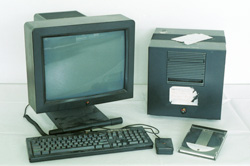
You can find there curiosities like the original computer used as the first web server, browser and editor (they even connected it to a projector!!!), their first thoughts on things like the first browser address bar, (which they did not thought it would be useful), or the opinions of the original team about the unfortunate name they gave to the WWW (they are still regretting it)

And my favorite one. They explained how Tim Berners-Lee usually stored the whole world wide web on a floppy disk because he was not confident of corporate back ups.

The video contains several funny pearls especially for all those, like myself that have been passionate about the Web this last 20 years; and perhaps tried to contribute a bit to the development of this extraordinary vehicle for innovation, communication and collaboration that is even changing some principles of world economy and business models ... bringing us the so-called open economy.

Happy 20th birthday World Wide Web!!!!! ...